One reshaped modern mathematics through geometry and topology; the other reshapes materials research through graph theory and AI. Mathematics and materials meet in their collaboration.
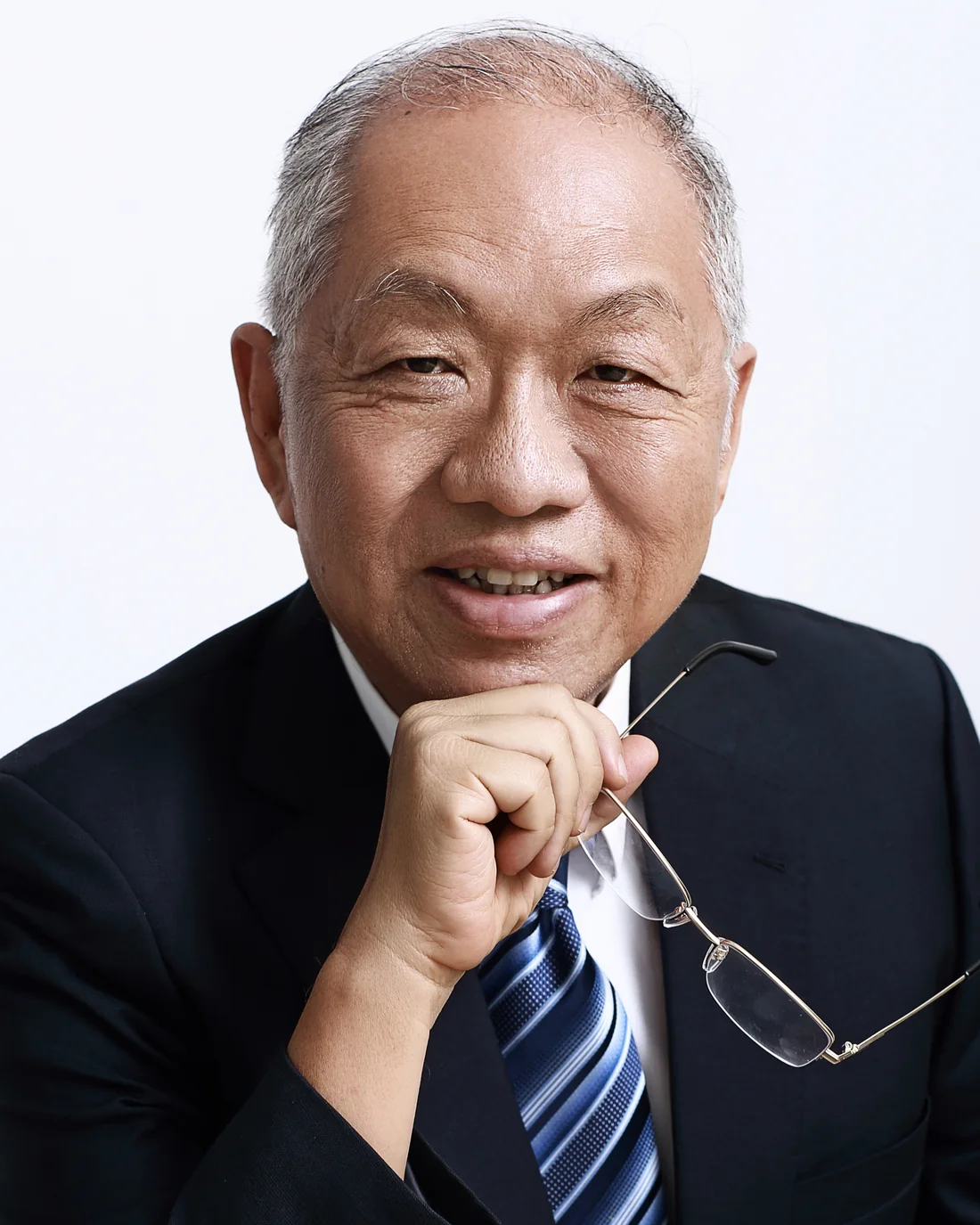
Director, Yau Mathematical Sciences Center, Tsinghua University
President, Beijing Institute of Mathematical Sciences and Applications
Member, US National Academy of Sciences · American Academy of Arts and Sciences · Foreign Member, Chinese Academy of Sciences · Russian Academy of Sciences
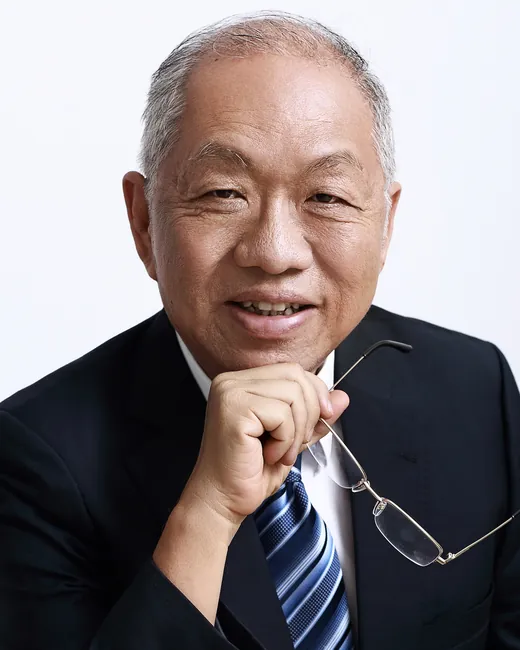
One of the founders of geometric analysis. In 1982 he became the first mathematician of Chinese descent to receive the Fields Medal. His proof of the Calabi conjecture gave rise to Calabi–Yau manifolds, now central to algebraic geometry and string theory. In recent years he has brought geometry, topology and graph theory into materials science: GLMY path homology, developed by his team, has become a key topological tool for directed material structures.
Graph-theoretic structural chemistry · Materials genome · AI for materials
Feng Pan
潘锋
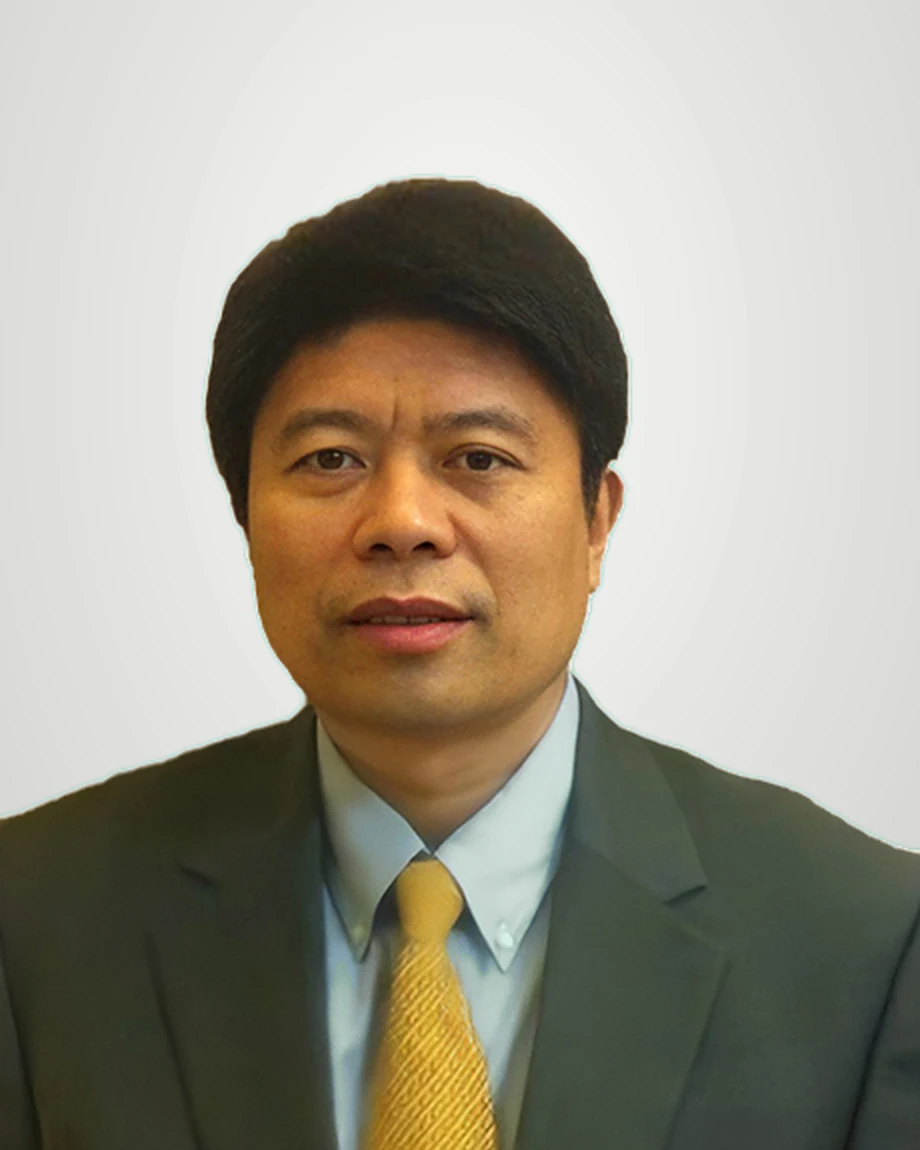
Chair Professor, Peking University
Founding Dean, School of Advanced Materials, PKU Shenzhen Graduate School
National Distinguished Expert · Fellow, Chinese Chemical Society
Chief Scientist, National Key R&D Program
Executive Editor-in-Chief, Chinese Journal of Structural Chemistry · Associate Editor, Journal of Materials Informatics · Associate Editor, Progress in Chemistry
Chair Professor at Peking University and Founding Dean of its School of Advanced Materials in Shenzhen. He created a graph-theory and topology-based theory of structural chemistry, built crystal-structure and materials-genome big data, and developed AI for materials and materials genomics. Using neutron and synchrotron facilities he built in-situ structural characterisation systems, and his breakthroughs in lithium-battery cathodes have reached industry: “from bookshelf to store shelf”.
Making mathematics the common language of materials and AI.
The Mathematics & Materials Laboratory is co-directed by Fields Medalist Shing-Tung Yau and Peking University Chair Professor Feng Pan. Built on geometry, topology and graph theory, and powered by AI, it asks how the structure of a material determines its properties, and develops a complete research chain from graph-theoretic structural chemistry through topological learning to AI-driven materials design.
We abstract the connections between atoms as graphs and complexes, describe connectivity, pores and directionality with topological invariants such as persistent homology and GLMY path homology, and combine them with machine learning and generative models for property prediction and inverse design. Predictions are tested against neutron, synchrotron and laboratory characterisation, and carried into energy, catalytic and extreme-environment materials.
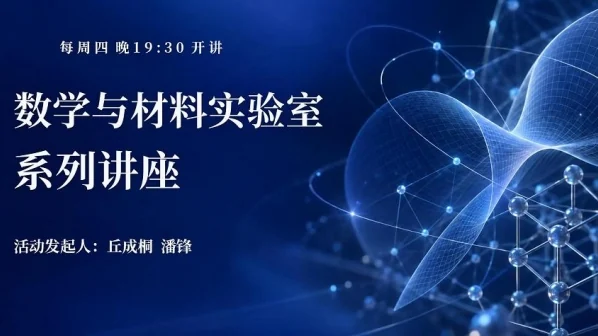
The laboratory is also an open forum: the Mathematics & Materials Seminar Series, initiated by the two co-directors, meets online and in person every Thursday at 19:30 (Beijing time).
Mathematics
Geometry · Topology · Graphs
GLMY path homology, persistent homology and algebraic graph theory give structure a computable language.
AI methods
Topological learning · Generative models
Topological invariants inside machine learning deliver accuracy with physical interpretability.
Materials
Materials genome · Structure–property
From 650,000 crystal structures to energy, catalytic and extreme-environment materials.
Validation
Large facilities · In-situ characterisation
Neutron and synchrotron characterisation holds every model to real structural data.
GLMY
Path homology of digraphs from Yau’s team, now applied in molecular and materials science
650k
Crystal structures in the database built on graph-theoretic structural chemistry and AI
0.032%
Resolution Δd/d of the neutron diffractometer built at the China Spallation Neutron Source
30+
Team papers on topology and graph theory for materials underpinning the Chemical Reviews article
03 · Research
From mathematical structure to real materials
Graph-theoretic structural chemistry, topological learning and AI-driven design: a research chain that starts from mathematics, is tested by experiment and reaches industry.
1
MathematicsGeometry · topology · graphs
2
RepresentationStructural graphs · invariants
3
LearningTopological learning · LLMs
4
DesignPrediction · inverse design
5
ValidationNeutron · synchrotron · in situ
6
TranslationBookshelf to store shelf
Pure Mathematics · A language for structure
Geometry and topology: a language for structure
The properties of a material are hidden in how its atoms are arranged and connected. We describe structure with graphs, simplicial complexes and digraphs, and extract global information — connectivity, rings, cavities — with topological invariants that stay stable as scale changes.
01GLMY path homology
An algebraic topology of digraphs from Yau’s team: ∂-invariant paths form a chain complex whose homology detects holes in directed structures; its persistent version tracks them across scales.
02Persistent homology & Euler curves
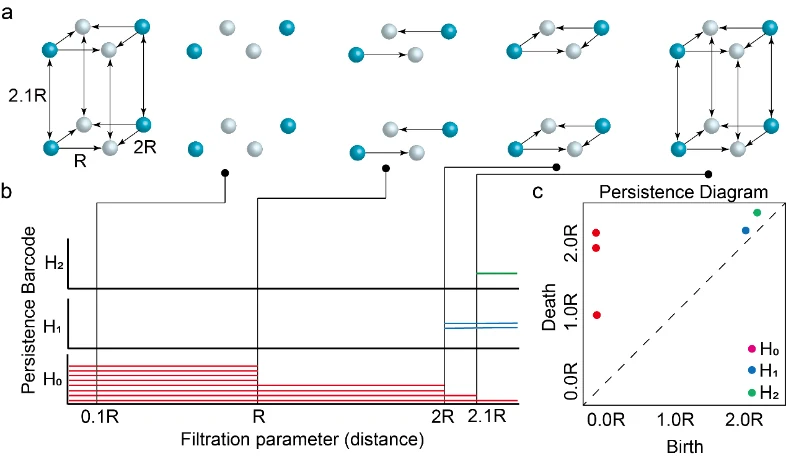
As the threshold ε grows, Vietoris–Rips complexes record the birth and death of components (H₀), rings (H₁) and cavities (H₂) as barcodes and persistence diagrams.
03Algebraic graph theory
Adjacency and Laplacian matrices and subgraph isomorphism make structural similarity computable, linking local coordination to long-range order.
04The geometric-analysis tradition
From Calabi–Yau manifolds to the positive mass theorem, geometric analysis set the paradigm of understanding shape through equations — the mathematical temperament of the lab.
Applied Mathematics · From structure to properties
Topological learning: from structure to properties
We fuse topological features with AI to reach accuracy from small data while keeping physical meaning, then reason back from target properties to structures for inverse design.
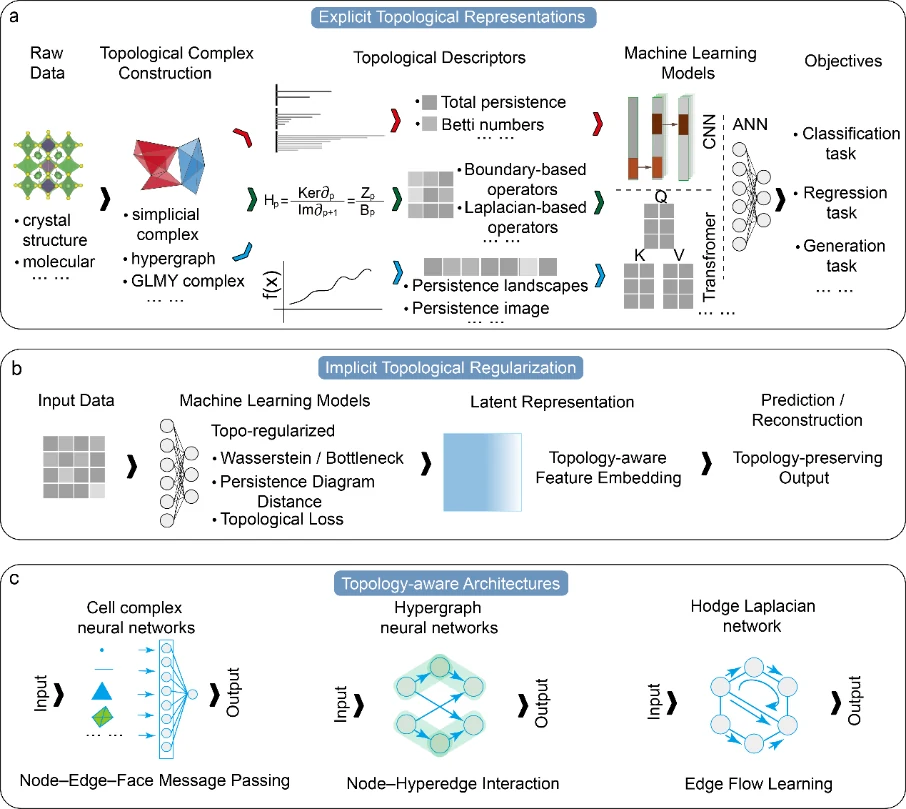
01Explicit topological features
Betti numbers, persistence statistics, landscapes and images as model inputs.
02Implicit topological regularisation
Wasserstein or bottleneck distances and topological losses keep latent spaces and outputs topologically faithful.
03Topology-aware networks
Cell-complex, hypergraph and Hodge-Laplacian networks encode higher-order relations in the architecture.
04Forward prediction + inverse design
PGH-VAE pairs persistent GLMY fingerprints with element information; trained on about 1,100 DFT samples it predicts *OH adsorption (MAE 0.045 eV) and generates optimal active-site configurations.
Three paradigms of topological learning: (a) explicit representations; (b) implicit regularisation; (c) topology-aware architectures.
Interdisciplinary Science · Bookshelf to store shelf
Materials genome: from mathematics to real materials
Materials problems drive the mathematics: from crystal-structure big data, energy and catalytic materials to extreme-environment materials for rotating detonation engines.
01Structural graphs & materials genome
A 650,000-structure database and automated structure analysis built on structural graphs and AI; subgraph isomorphism mines fast ion conductors and graph search finds one-dimensional materials.
02Energy materials
Structure–property relations and failure mechanisms of Li-rich, Ni-rich and LiCoO₂ cathodes, leading to high-voltage, high-capacity LiCoO₂ in industrial production.
03Catalysis
Topology-guided sampling finds active phases, graph theory with active learning maps urea-synthesis pathways, and topological generative models design active sites on high-entropy alloys.
04Large-facility characterisation
A high-resolution neutron diffractometer at the China Spallation Neutron Source (Δd/d = 0.032%), combined with synchrotron in-situ dynamic characterisation.
Rotating-detonation combustors face high-frequency detonation waves, extreme heat and thermal shock. We extend topological and graph descriptions to superalloys, thermal barrier coatings and ceramic-matrix composites, characterising how pore and crack networks connect and evolve under thermal cycling.
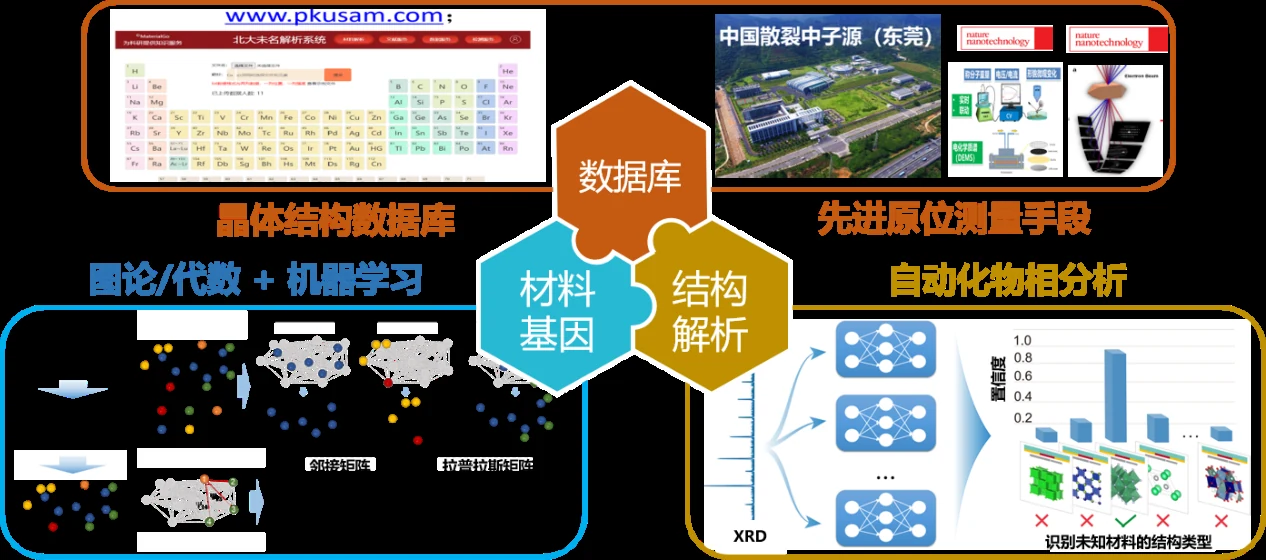
The materials-genome system: crystal-structure database, graph theory and algebra with machine learning, advanced in-situ measurement and automated phase analysis.
04 · Topology Lab
Compute the topology of materials yourself
Two live computations. Every number is produced in your browser by boundary-matrix reduction — change the structure and watch the topology respond.
Click empty space to add an atom; click an atom to remove ittriangles
Seeing pores in a graphene lattice
Atoms closer than ε are joined, and triangles fill in when all three pairs are joined (the Vietoris–Rips complex). Drag ε: hexagonal rings are born at 1.42 Å and filled at 2.46 Å, while a nanopore leaves a much longer H₁ bar.
–β₀ · components
–β₁ · rings / pores
Persistence barcode
Persistence diagramH₀ ● H₁ ●
Click an edge to reverse it
Path homology on digraphs
Ion migration, charge transfer and reaction networks in materials all have direction. GLMY path homology takes direction into account: the same graph can have entirely different holes with and without it. Click an edge to reverse it.
Ignoring direction · clique complex
Keeping direction · GLMY path homology
∂-invariant 2-paths (basis of Ω₂)
Methods: Vietoris–Rips filtration to the 2-skeleton with column reduction over F₂; GLMY path homology over ℝ via Ω_k = {v ∈ A_k : ∂v ∈ A_{k−1}} and rank computations.
05 · Publications
Selected publications
Every paper links to its DOI; volumes and pages are checked against Crossref.
CHEMICAL REVIEWS · 2026Yau × Pan
Topological Data Analysis in Materials Science: Principles, Machine Learning Integration, and Application Landscapes
Reviews persistent homology, persistent GLMY homology and Euler characteristic curves, sets out three paradigms of topological learning and maps applications of TDA + AI across materials science. Feng Pan and Shing-Tung Yau are among the corresponding authors.
Shisheng Zheng, Bingxu Wang, … , Jian-Feng Li, Shing-Tung Yau, Feng Pan · Chemical Reviews 126 (12), 7029–7067 (2026)
Bingxu Wang, Shisheng Zheng, Jie Wu, Jingyan Li, Feng Pan
npj Computational Materials 11, 147 (2025)
Uses persistent GLMY homology as a topological fingerprint with a variational autoencoder for interpretable inverse design of active sites on high-entropy alloys; *OH adsorption energies are predicted with a mean absolute error of 0.045 eV from about 1,100 DFT samples.
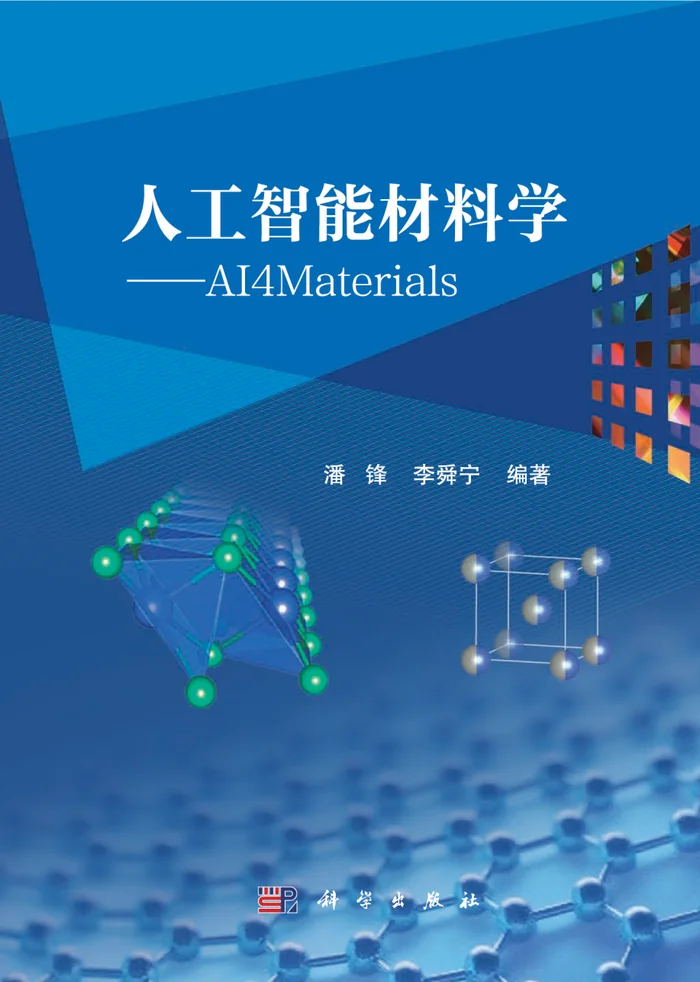
Feng Pan & Shunning Li · Preface by Shing-Tung Yau
The book sets out how AI is transforming the research paradigm of materials science across the whole chain — feature extraction, property prediction and inverse design, structural evolution, characterisation and knowledge discovery — and looks ahead to the “AI materials scientist”. Each chapter contrasts how people and AI do research, drawing on the authors’ years of work in graph-theoretic structural chemistry and materials genomics and more than 30 of the team’s papers.
The AI era has just begun. Let mathematics be our bond, and explore new possibilities where numbers meet atoms.
01Materials science and its paradigm shiftspp. 1–55
From “one generation of materials, one generation of industry” to the new paradigms of materials genome, big data and AI.
1.1One generation of materials, one era1
1.2From engineering to science4
1.3New paradigm: materials genome and big data29
1.4New paradigm: AI for materials36
02Microscopic description and feature extractionpp. 56–109
Descriptions by atomic positions and by connectivity: local environments, long-range order and topological data analysis.
2.1Classical structural descriptions56
2.2Structural features for AI69
03Property prediction and inverse designpp. 110–143
From classical computation to machine learning and generative models; forward prediction versus inverse design.
3.1Classical prediction methods111
3.2AI algorithms for prediction118
3.3Progress in AI prediction123
3.4Challenges and outlook136
04Structural evolution and dynamicspp. 144–182
Multiscale simulation and machine-learned interatomic potentials for ion transport and phase transitions.
4.1Microstructural evolution and multiscale simulation144
4.2AI interatomic potentials149
4.3Simulating ion transport163
4.4Simulating phase transitions167
4.5Challenges and outlook177
05Characterisation and spectral analysispp. 183–228
AI analysis of diffraction, spectroscopy and imaging across modalities, scales and in-situ experiments.
5.1Characterisation techniques183
5.2AI spectral analysis207
5.3AI image analysis218
5.4Challenges and outlook223
06Knowledge discovery and intelligent analysispp. 229–267
Natural-language processing, word embeddings, pretrained language models and knowledge graphs for materials knowledge.
6.1NLP and knowledge discovery229
6.2Word-embedding encodings240
6.3Pretrained language models246
6.4Large models and knowledge graphs253
6.5Challenges and outlook263
07The AI materials scientistpp. 268–
Prediction, decision and experiment working together, towards a closed-loop AI materials scientist.
7.1AI-driven materials manufacturing268
7.2A fully coordinated AI materials scientist278
7.3Challenges and outlook287
07 · Conferences
Seminars and conferences
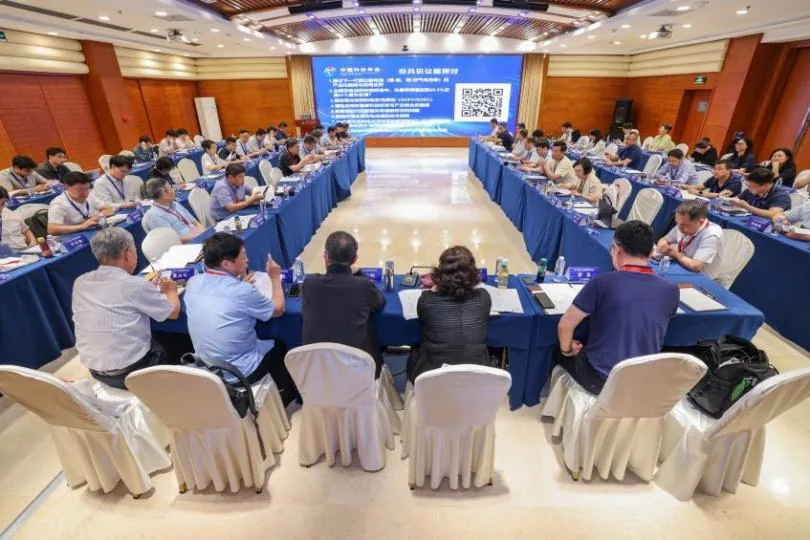
Initiated by Shing-Tung Yau and Feng Pan, the series brings together mathematicians, materials scientists, physicists and AI researchers around three questions: how mathematics describes structure, how AI learns structure–property relations, and how experiments test models.
Seminar series
Mathematics & Materials Seminar Series
Thursdays 19:30 (Beijing time) · online and in person
Initiated by Shing-Tung Yau and Feng Pan
Talks span geometry and topology, metamaterials and mathematics, the materials genome and AI.
09.132026 · Sun 15:30Past
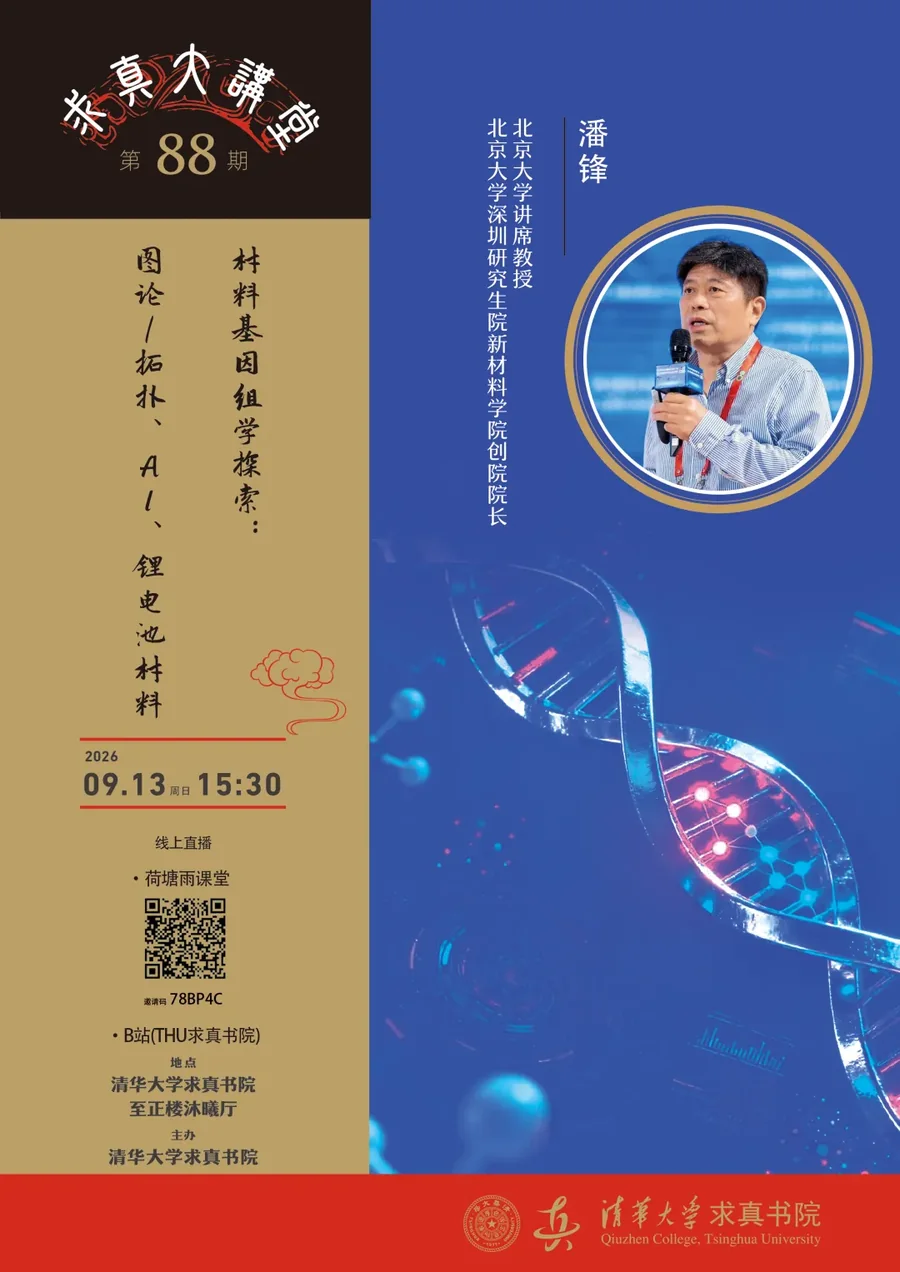
Exploring materials genomics: graph theory and topology, AI, and lithium-battery materials
Feng PanChair Professor, Peking University; Founding Dean, School of Advanced Materials
Muxi Hall, Zhizheng Building, Qiuzhen College, Tsinghua University (Qiuzhen Lecture No. 88), streamed live by the seminar series (Yuketang; Bilibili “THU求真书院”)
08.262026 · Wed 19:30–21:00Past
When metamaterials meet mathematics: a path from mathematical models to physical realisation and materials empowerment
Ji ZhouAcademician, Chinese Academy of Engineering; Professor, School of Materials Science and Engineering, Tsinghua University
Mathematics & Materials Seminar Series · online and in person
Forums & talks
Talks and forums
Recent plenary talks, forums and lectures by co-director Feng Pan.
Early August 2026
A new paradigm uniting AI and structural chemistry
Feng Pan · Beijing · 28th CAST Annual Meeting, forum on new batteries and key energy-storage materials
In the session on AI-enabled batteries he presented a new paradigm of materials R&D uniting AI and structural chemistry; the forum also debated whether AI for Science can reshape electrochemical research.
AI for Materials: exploring the genes of lithium-battery materials
Feng Pan · Online · Keyanyun live room (Bilibili 22019344)
Covers the three pillars of AI4M — graph-theoretic structural chemistry, the lithium-battery materials genome and dual-path AI (forward prediction + inverse design). The replay is titled “Breaking the trial-and-error impasse in battery materials”.
AI for materials: exploring lithium-battery materials genomics
Feng Pan · Peking University · 2026 Boya Materials Frontier Summer School (AI-driven design and manufacturing of new materials)
Starting from paradigm shifts in materials science, he set out how to explore new paradigms “with mathematics as the bond, where numbers meet atoms”, explained structure–property relations through LiFePO₄ and NCM cathodes, and shared results on solid-state batteries and one-dimensional materials.
18 July 2026
Keynote: technology pathways for Shenzhen–Dongguan innovation
Feng Pan · Songshan Lake, Dongguan · 2026 annual meeting of the Science Alliance of the Greater Bay Area National Science Centre pilot zone
Keynote alongside Academicians Wang Weihua (Dongguan Institute of Materials Science and Technology, CAS) and Ma Yuguang (South China University of Technology) on the technology pathways for joint innovation.
Led by Feng Pan · Online · Keyanyun lecture series and launch of AI4Materials
One lecture per chapter: paradigm shifts, microscopic description, prediction and inverse design, structural evolution, characterisation, knowledge discovery, and the AI materials scientist (lecture 5 on 22 November, 19:30).
Exploring the materials genome of solid-state lithium batteries
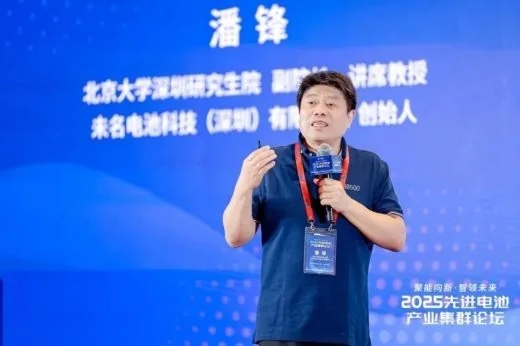
Feng Pan · Shenzhen · 2025 Advanced Battery Industry Cluster Forum (plenary)
The core of exploring the materials genome is to encode functional groups with graph theory and to design and predict through materials genomics, graph big data, AI, large language models and large facilities; the talk also addressed key challenges of solid-state batteries and new cathode materials.
Compiled from joint publications, AI4Materials and the seminar series.
10 · Join Us
Bring your discipline to a question worth solving
We welcome people from mathematics, physics, chemistry, materials and computing to do original work across disciplines.
We look for scholars with deep expertise in geometry, topology, graph theory, computational materials, structural chemistry or machine learning who want to commit to research between mathematics and materials.
Send a CV, representative work and a research statement to the academic contact address, with “Mathematics & Materials Lab + position” in the subject line.
Theory and algorithms of GLMY path homology and persistent homology
Topological learning and interpretable AI
Materials genome and automated structure analysis
Characterisation and design of extreme-environment materials
For PhDs in mathematics, physics, chemistry, materials or computer science to pursue independent research in topological data analysis, AI materials design and the analysis of large-facility data.
Send a CV, representative work and a research statement to the academic contact address, with “Mathematics & Materials Lab + position” in the subject line.
Persistent GLMY homology for ion transport and reaction networks
Topology-aware neural networks and generative models
AI analysis of neutron and synchrotron data
Topology of pore and crack networks in high-temperature materials
Undergraduate and graduate students interested in mathematics and materials are welcome to attend the seminar series, read AI4Materials and join research training; graduate admission follows the policies of the degree-granting institutions.
Send a CV, representative work and a research statement to the academic contact address, with “Mathematics & Materials Lab + position” in the subject line.
First Fields Medalist of Chinese descent · Dean, Qiuzhen College, Tsinghua University · Director, Yau Mathematical Sciences Center, Tsinghua University · President, Beijing Institute of Mathematical Sciences and Applications
Biography
Shing-Tung Yau was born in Shantou, Guangdong, in April 1949. He entered the Department of Mathematics of The Chinese University of Hong Kong in 1966 and completed his undergraduate studies in three years. In 1969 he went to the University of California, Berkeley, where he received his PhD in 1971 under the geometer Shiing-Shen Chern.
In the 1970s he resolved a series of celebrated problems in mathematics and physics and founded geometric analysis. His proof of the Calabi conjecture made Calabi–Yau spaces fundamental models in algebraic geometry, number theory and high-energy physics, and with Richard Schoen he proved the positive mass theorem of general relativity. Several Fields Medals have since been awarded for work in the direction he opened.
His theories have shaped physics and engineering. He was professor of mathematics and of physics at Harvard University, chaired its Department of Mathematics, and founded the Harvard Center of Mathematical Sciences and Applications. He has also published dozens of papers on control theory, graph theory, data analysis, artificial intelligence and 3D image processing. He has supervised more than 70 PhD students and a similar number of postdoctoral fellows, many of whom are now leading mathematicians in China and abroad.
Since 2022 he has worked full time at Tsinghua University as Dean of Qiuzhen College and Director of the Yau Mathematical Sciences Center, and he is President of the Beijing Institute of Mathematical Sciences and Applications. He also initiated research platforms including the Hetao Institute of Mathematics and Interdisciplinary Sciences in Shenzhen.
Education
The Chinese University of Hong Kong, MathematicsUndergraduate studies, completed in three years
University of California, BerkeleyPhD, advised by Shiing-Shen Chern
Career
Institute for Advanced Study, PrincetonMember
Stony Brook UniversityAssistant Professor
Stanford University, MathematicsProfessor
University of California, BerkeleyVisiting Professor
Institute for Advanced Study, PrincetonProfessor
UC San Diego, MathematicsChair Professor
Harvard University, MathematicsProfessor; William Caspar Graustein Professor of Mathematics from 2000, now emeritus
Institute of Mathematical Sciences, CUHKDirector
The Chinese University of Hong KongDistinguished Professor-at-Large
Harvard University, MathematicsDepartment Chair
Mathematical Sciences Center, Tsinghua (now YMSC)Director
Harvard University, PhysicsProfessor
Harvard Center of Mathematical Sciences and ApplicationsFounding Director
Beijing Institute of Mathematical Sciences and ApplicationsPresident
Qiuzhen College, Tsinghua UniversityDean
Honours
Shaw Prize in Mathematical Sciences
Marcel Grossmann Award
Wolf Prize in Mathematics
Asian American Engineer of the Year Award
International Scientific and Technological Cooperation Award of China
US National Medal of Science
Crafoord Prize, Royal Swedish Academy of Sciences
Humboldt Research Award
MacArthur Fellowship
Fields Medal, International Congress of Mathematicians
John J. Carty Award, NAS; Oswald Veblen Prize in Geometry, AMS
Guggenheim Fellowship
California Scientist of the Year
Sloan Research Fellowship
Scholarship
According to MathSciNet (1970–2019), he published 528 papers across more than 30 fields, including 11 in Inventiones Mathematicae and 8 in Annals of Mathematics.
In 2015, with Po-Ning Chen and Mu-Tao Wang, he published “Conserved quantities in general relativity: from the quasi-local level to spatial infinity”.
In 2017, with Benjamin Allen, Martin Nowak and others, he published “Evolutionary dynamics on any population structure” in Nature, using coalescence times of random walks to predict when cooperation is favoured on any population structure.
Mathematics meets materials
His team developed GLMY theory, the path homology of Grigor’yan, Lin, Muranov and Yau: an algebraic-topological method for asymmetric, directed graphs. Where classical persistent homology describes undirected structure, GLMY theory also captures direction, hierarchy and complex relations, giving a new framework for materials governed by transport, diffusion and reaction.
In 2023, with the team of Feng Pan and with Guo-Wei Wei of Michigan State University, he published “Path Topology in Molecular and Materials Sciences” in J. Phys. Chem. Lett., the first systematic application of GLMY theory to molecular and materials science.
In September 2025 he wrote the preface to AI4Materials, describing mathematics as the common “language” of materials science and AI. In 2026 he and Feng Pan were corresponding authors of a Chemical Reviews article on topological data analysis in materials science.
Chair Professor, Peking University · Founding Dean, School of Advanced Materials, PKU Shenzhen Graduate School · National Distinguished Expert · Fellow, Chinese Chemical Society · Chief Scientist, National Key R&D Program
Biography
Feng Pan is a Chair Professor and doctoral supervisor at Peking University, a National Distinguished Expert, a Fellow of the Chinese Chemical Society, a Chief Scientist of the National Key R&D Program and the Founding Dean of the School of Advanced Materials at Peking University Shenzhen Graduate School. Addressing key problems of the new-energy and new-materials industries, he built a system for creating new materials on AI and on the graph-theoretic structural chemistry and materials genomics he developed; built scientific facilities, methods and analysis systems for structural characterisation; and revealed structure–property relationships in energy materials, with breakthroughs in lithium-battery cathodes that have been transferred to industry.
He created a graph-theory and topology-based theory of structural chemistry, established in-situ dynamic characterisation built on neutron and synchrotron facilities, and developed AI for materials and materials genomics, uncovering basic laws that link materials genes to properties. His work on the energy density, power density and cycling stability of lithium batteries has gone “from bookshelf to store shelf”. As corresponding author he has published more than 600 papers in journals including Nature, Nature Energy, Nature Nanotechnology and Chemical Reviews (h-index 103).
He led the construction of a high-resolution neutron powder diffractometer at the China Spallation Neutron Source, reaching a resolution of Δd/d = 0.032%, built a database of 650,000 crystal structures on graph-theoretic structural chemistry and AI, and developed an automated structure-analysis system. AI4Materials, which he co-authored with Shunning Li, was published by Science Press in 2025 with a preface by Shing-Tung Yau.
Education
ETH ZürichPostdoctoral researcher
University of StrathclydePhD
Fujian Institute of Research on the Structure of Matter, CASMSc
Peking University, ChemistryBSc
Service
Executive Editor-in-Chief, Chinese Journal of Structural Chemistry; Associate Editor, Journal of Materials Informatics and Progress in Chemistry
Board member, International Academy of Electrochemical Energy Science (IAOEES); Vice President, International Automotive Lithium Battery Association (IALB)
Head, International Joint Research Center for Power Batteries and Materials (MOST international cooperation base)
Director, Guangdong Key Laboratory of Design and Calculation of New Energy Materials; Shenzhen Key Laboratory of New Energy Materials Genome Preparation and Testing
Research areas
AI for Science: graph theory and AI for the study of matter and new materials
Graph-theoretic structural chemistry; crystal-structure and materials-genome big data
High-resolution neutron diffractometer at the China Spallation Neutron Source
Structure-analysis systems combining materials big data and AI
Honours
Elsevier Highly Cited Chinese Researchers, eleven consecutive years
Clarivate Highly Cited Researcher, four consecutive years
World’s Top 2% Scientists, career and single-year lists, six consecutive years
ScholarGPS Highly Ranked Scholar, top 0.05%
Special Government Allowance of the State Council
7th China Electrochemistry Contribution Award; Guangdong Special Support Program Outstanding Talent; PKU Outstanding Graduate Supervisor
Lithium-battery work selected among China’s 100 most influential international papers
Battery Division Technology Award, The Electrochemical Society
The seminar series invites mathematicians, materials scientists, physicists and AI researchers. Recent speakers:
This list is updated as the series continues.
People
Research Support
The laboratory’s research draws on the platforms and large facilities of the co-directors’ institutions:
Mathematics
Yau Mathematical Sciences Center, Tsinghua University
Qiuzhen College, Tsinghua University
Beijing Institute of Mathematical Sciences and Applications
Materials
School of Advanced Materials, PKU Shenzhen Graduate School
International Joint Research Center for Power Batteries and Materials (MOST)
Guangdong Key Laboratory of Design and Calculation of New Energy Materials
Shenzhen Key Laboratory of New Energy Materials Genome Preparation and Testing
Facilities & data
High-resolution neutron diffractometer at the China Spallation Neutron Source (Δd/d = 0.032%)
Synchrotron in-situ dynamic characterisation
650,000-structure crystal database and automated structure analysis
Reading
On the preface: mathematics as a common language
In his preface Yau argues that materials science and AI share a hidden common language: mathematics. Group theory, statistical mechanics and partial differential equations have long been the quantitative core of materials science; in the AI era, linear algebra, probability and optimisation let algorithms read materials. He highlights GLMY theory, which extracts topological invariants from geometry to describe the 3D connectivity and voids of atomic structures — a solid basis for structure–property modelling and machine learning.
Mathematics provides the firmest theoretical foundation for the revolution at the crossing of materials science and AI.
In extracting structural features, mathematics builds the bridge from microstructure to computable data.
Three questions for readers
How does structure become a computable object, starting from atomic coordinates?
Which local and global information do graphs and topology keep, and how should direction be expressed?
How do the mathematical features in a model correspond to physical meaning in the material?
Shing-Tung Yau, preface to AI4Materials (September 2025); Feng Pan and Shunning Li, Science Press, 2025. This page is a reading guide and does not reproduce the book.
Seminar series
Exploring materials genomics: graph theory and topology, AI, and lithium-battery materials
2026.09.13(Sun)15:30 Beijing time
Feng PanChair Professor, Peking University; Founding Dean, School of Advanced Materials
Muxi Hall, Zhizheng Building, Qiuzhen College, Tsinghua University (Qiuzhen Lecture No. 88), streamed live by the seminar series (Yuketang; Bilibili “THU求真书院”)
Abstract
The talk presents a graph-theory and topology-based system of structural chemistry; crystal-structure and materials-genome big data combined with AI to build materials genomics and explore the genes and structure–property relations of lithium-battery materials; and structural characterisation at synchrotron and neutron facilities that has led to breakthroughs in high-performance battery materials and their industrialisation.
About the speaker
Feng Pan is Chair Professor at Peking University, Founding Dean of the School of Advanced Materials, Fellow of the Chinese Chemical Society and Executive Editor-in-Chief of the Chinese Journal of Structural Chemistry. He created a graph-theory and topology-based structural chemistry, built in-situ dynamic characterisation at neutron and synchrotron facilities, and developed AI for materials and materials genomics. As corresponding author he has published 550+ papers in journals including Nature, Nature Energy, Nature Nanotechnology and Chemical Reviews, cited over 50,000 times (h-index 103). His honours include the China Electrochemistry Contribution Award, the Shenzhen Natural Science Award (first prize) and the ECS Battery Division Technology Award.
Source: seminar announcement and poster.
Seminar series
When metamaterials meet mathematics: a path from mathematical models to physical realisation and materials empowerment
2026.08.26(Wed)19:30–21:00 Beijing time
Ji ZhouAcademician, Chinese Academy of Engineering; Professor, School of Materials Science and Engineering, Tsinghua University
Mathematics & Materials Seminar Series · online and in person
Abstract
Metamaterials use artificial structural units to achieve properties not found in nature, and meta-materials science carries these principles into conventional materials. Their development is inseparable from mathematics. The talk explores deeper integration: mathematics inspires, designs and optimises new metamaterials, while metamaterials, as physical images of mathematics, offer a way for mathematics to move from formal to empirical science — pointing to a general, paradigmatic path by which mathematics empowers materials.
About the speaker
Ji Zhou is Professor at the School of Materials Science and Engineering, Tsinghua University, and an Academician of the Chinese Academy of Engineering. He graduated from Jilin University (1983), received an MSc from the Changchun Institute of Physics, CAS (1986) and a PhD in chemistry from Peking University (1991), and has since been postdoc, associate professor and professor at Tsinghua. He chairs the academic committee of Tsinghua’s School of Materials, convened the materials discipline group of the 8th Academic Degrees Committee of the State Council, and is vice president of the China International Association for Promotion of Science and Technology and president of the Beijing Society of Interdisciplinary Science. His research covers metamaterials, artificial matter systems, meta-materials science and functional ceramics: 500+ papers, 3 monographs, 70+ patents, and second-class State Natural Science and Technological Invention Awards.